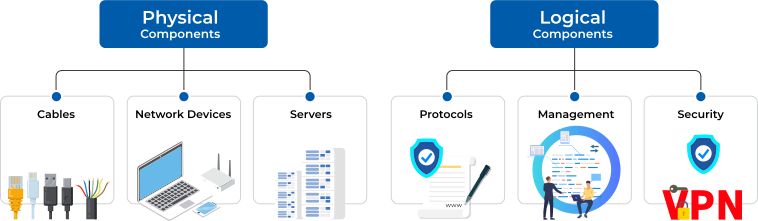
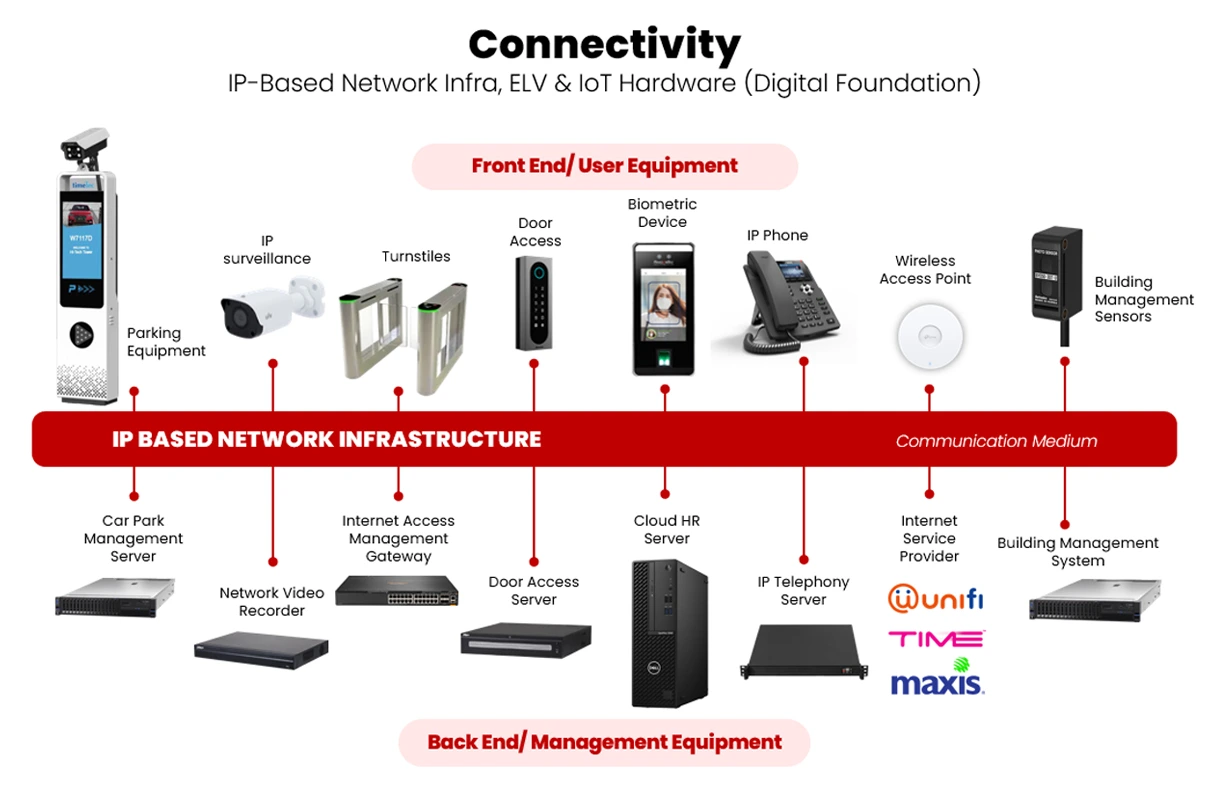
TimeTec offers complete Network Infrastructure solutions alongside our comprehensive PropTech ecosystem, delivering seamless connectivity to support smart building operations. From structured cabling to high-performance network equipment, our infrastructure services are designed to integrate flawlessly with TimeTec’s PropTech solutions—including smart access and elevator control, ELV & IoT automation, smart cashless and touchless parking, visitor management and etc., ensuring a reliable, scalable, and future-ready environment for modern commercial and residential buildings.
What Is a Well-Designed Network Infrastructure?
A well-designed network infrastructure is essential for any organization that relies on technology to operate effectively. It provides the foundation for integrating emerging technologies and new applications, allowing businesses to remain agile, up-to-date, and competitive in their industries.
For service providers, building a robust network infrastructure means ensuring scalability, high availability, and intelligent load balancing. These elements are critical to maintaining seamless connectivity and reliable system performance—key factors in today’s fast-paced digital environment.
Since network interruptions can never be entirely avoided, it's also vital to adopt streamlined network architectures and automated management tools. These help network administrators quickly identify, isolate, and resolve issues, minimizing downtime and ensuring optimal network functionality.
In 2024, each penny cost approximately 3.69 cents to produce and distribute. This resulted in an annual loss of roughly $85.3 million for the Treasury.
The status of the penny and nickel has shifted significantly in 2026, with the penny officially exiting production. While pennies already in circulation remain legal tender, the U.S. Treasury stopped manufacturing new one-cent coins due to extreme production losses.
As of late 2025/early 2026, the U.S. Mint has ended regular production of the penny.
With the penny retired, the nickel is now the lowest-denomination coin, leading to debate over its long-term viability. Report Elimination of the Penny: Cents-able Considerations
The last regular minting of the penny occurred in November 2025 , with future production limited to ceremonial sets.
For cash transactions, retailers are increasingly adopting symmetrical rounding , where totals are rounded up or down to the nearest five cents. Digital and non-cash transactions still use exact cent increments. The Looming "Nickel Problem"
Penny Nickels ⚡
In 2024, each penny cost approximately 3.69 cents to produce and distribute. This resulted in an annual loss of roughly $85.3 million for the Treasury.
The status of the penny and nickel has shifted significantly in 2026, with the penny officially exiting production. While pennies already in circulation remain legal tender, the U.S. Treasury stopped manufacturing new one-cent coins due to extreme production losses.
As of late 2025/early 2026, the U.S. Mint has ended regular production of the penny.
With the penny retired, the nickel is now the lowest-denomination coin, leading to debate over its long-term viability. Report Elimination of the Penny: Cents-able Considerations
The last regular minting of the penny occurred in November 2025 , with future production limited to ceremonial sets.
For cash transactions, retailers are increasingly adopting symmetrical rounding , where totals are rounded up or down to the nearest five cents. Digital and non-cash transactions still use exact cent increments. The Looming "Nickel Problem"